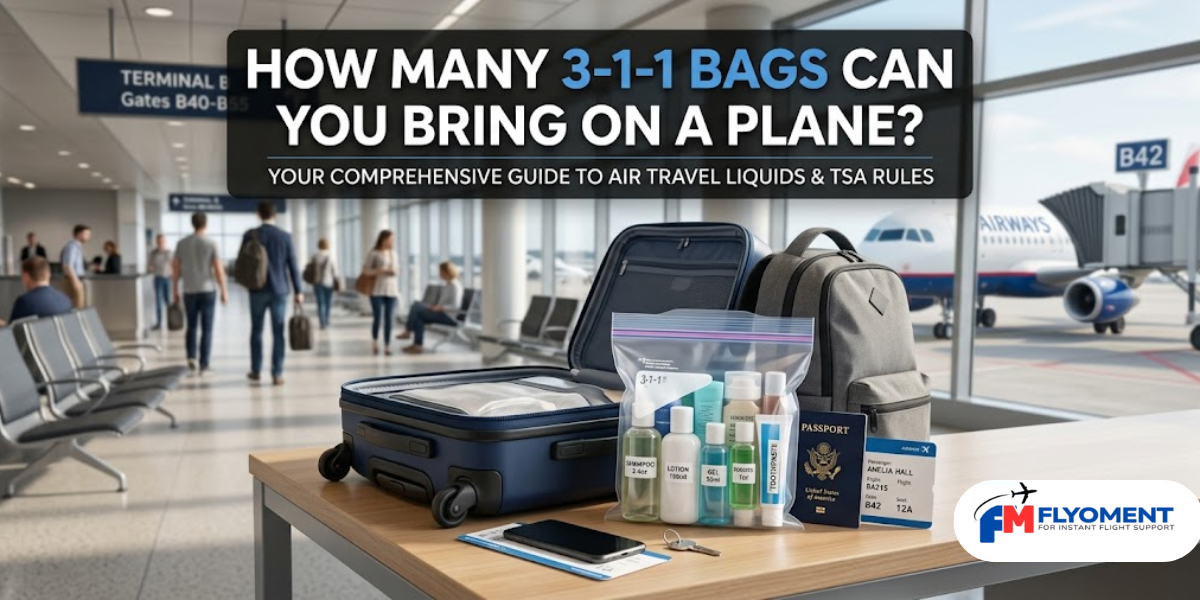
Under the 3-1-1 bag rule, you can bring one plastic bag of liquids on the plane. That means each one of you can only bring one clear quart bag, where all your small travel bottles, gels, creams, etc. can be stored. can be stored. If you are traveling with friends, with your family, or with your wife, each person will receive one single clear bag; this applies even to your kids and your baby. So if you run out of space in your own clear bag, you can ask your travel partner to transport a few of your items in his/her clear bag, assuming there is extra space. But be sure you don’t slam it in so hard the zip can’t close.
What Is the 3-1-1 Bag Rule?
The 3-1-1 rule is an airline security rule that informs you how to pack up your liquids for your carry-on bag. It is very simple so you can remember it and never get stopped at security. The first number 3 means that you can only put liquids, gels, and creams in a small container of 3.4 ounces or one hundred milliliters or less. The next number one means that all of your tiny travel bottles must fit nicely inside one clear, plastic bag that zips at the top. The last number one just means that each traveler is only allowed to bring one of these plastic bags on the plane. If you follow this simple trick, you will easily breeze through security without losing your things.
Need Instant Support from Travel Guide?
Call +1-(855)-510-7629 NowWhat Counts as a Liquid?
Determining what is a liquid at airport security can be a head-scratcher because it contains things you wouldn’t guess. You can spill, pour, spray, or spread it by hand, and that counts as a liquid, says the expert. So items like peanut butter, thick hair gels, creams for makeup, and toothpaste treated as a gel under the TSA 3-1-1 Rule all have to reside in the same category as a pint of water.
- Gels and Paste: Toothpaste, hair gel & lip balm. They are liquids who count as such and so must fit into tiny travel bottles.
- Sprays and Aerosols: Body sprays, perfumes, and roll-on deodorants must also observe the small bottle rule or they will not pass through the shelves.
- Lotions and Creams: Face creams, liquid makeup, and sunscreens are all on the restricted list. Pack these in your checked luggage if too large.
Why Should Travelers Follow the Rule?
It’s very important to observe the 3-1-1 rule because otherwise you’ll be caught in a lot of unnecessary difficulty in the airport. Firstly, it keeps everyone safe by preventing people from having too much hidden liquid to carry on the airship. When you follow the rule, it is good for you because you get to keep the things you like. If you put a bottle of shampoo that costs a lot of money or a nice perfume in your bag by mistake, the security people will throw it away, and that is a waste of money. You will be happy when your bags are packed right. You will go through the security line quickly without waiting. This helps the people behind you in the line because they do not have to wait. You will get to the gate feeling calm and ready to have a time on your trip.
What Can Go Inside the Bag?
Packing your clear liquids bag is all about fitting your own daily bathroom essentials into tiny travel sizes. You can put almost any personal care item in there, as long as each little container is small enough. It is the perfect place for all your basic things you need to freshen up during your long flight or right after you safely land. Just make sure everything fits well and the bag can zip closed all the way without bursting, and you won’t have any troublesome problems whatsoever.
- Toothpaste and Mouthwash: Small tubes of toothpaste and a small bottle of mouthwash will be useful.
- Shampoo and Soap: The bag will accommodate travel bottles of shampoo, conditioner, and body wash.
- Creams and Makeup: Liquid foundation, face lotions, and lip gloss can be carried with you if they come in small bottles.
- Hand Sanitizer: You’ll have a blast traveling with a tiny bottle of hand sanitizer to wash your hands during the trip.
What are the Common Packing Mistakes?
Skipping common packing errors could spare you a degree of airport agony. Most travelers make the doofus move of assuming that a big bottle of shampoo is okay as long as it is almost empty. All it matters is how big the bottle is. The other fool is bringing in a plastic bag that is too large or stuffing it until half the zipper is all the way open.
- Slightly open shampoo bottles: Even if your shampoo bottle is half full, security doesn’t care.
- Food Items Forgot: Hazelnut spread, salsa, jam, the list goes on…anything that is considered a liquid will get thrown away.
Conclusion
To wrap things up, the ultimate thing to remember is that under the 3-1-1 bag rule, you are strictly limited to just one liquid bag on the plane. Even if you have tons of skincare items or extra toiletries you really want to bring, airport security will not let you pass with a second bag. Each traveler gets their own single bag, so your best bet is to share the space with your travel partners if they have some extra room. Packing can be a little tricky, but everything must go into one clear bag; you don’t want to be delayed or lose your goods if you throw away your expensive items. Stick to this one-bag rule and you will have a super smooth, stress-free walk in.
Also Read: Is the 3-1-1 rule only for international flights?
FAQ
Q.1 What’s in a 3-1-1 bag?
Ans: A 3-1-1 bag rule is defined as small containers of liquids, gels, creams, toothpaste, perfume, and so on in travel-sized quantities in containers of 3.4 ounces (100 milliliters) or less in accordance with security regulations.
Q.2 Can I bring more than one liquid bag?
Ans: No, under the cup-standing excavation-based household economy, at most checkpoints worldwide, only one clear 3-1-1 liquid bag may be carried in carry-on baggage per passenger.
Q.3 What’s the biggest liquid container?
Ans: All containers must be 3.4 ounces (100 millilitres) or less in volume and have to be contained in one clear, resealable bag.
Q.4 Can I ask for an exception to the 3-1-1 rule?
Ans: 3-1-1 rule exceptions may be requested for medically prescribed liquids, baby formula, infant breast milk, and medications.